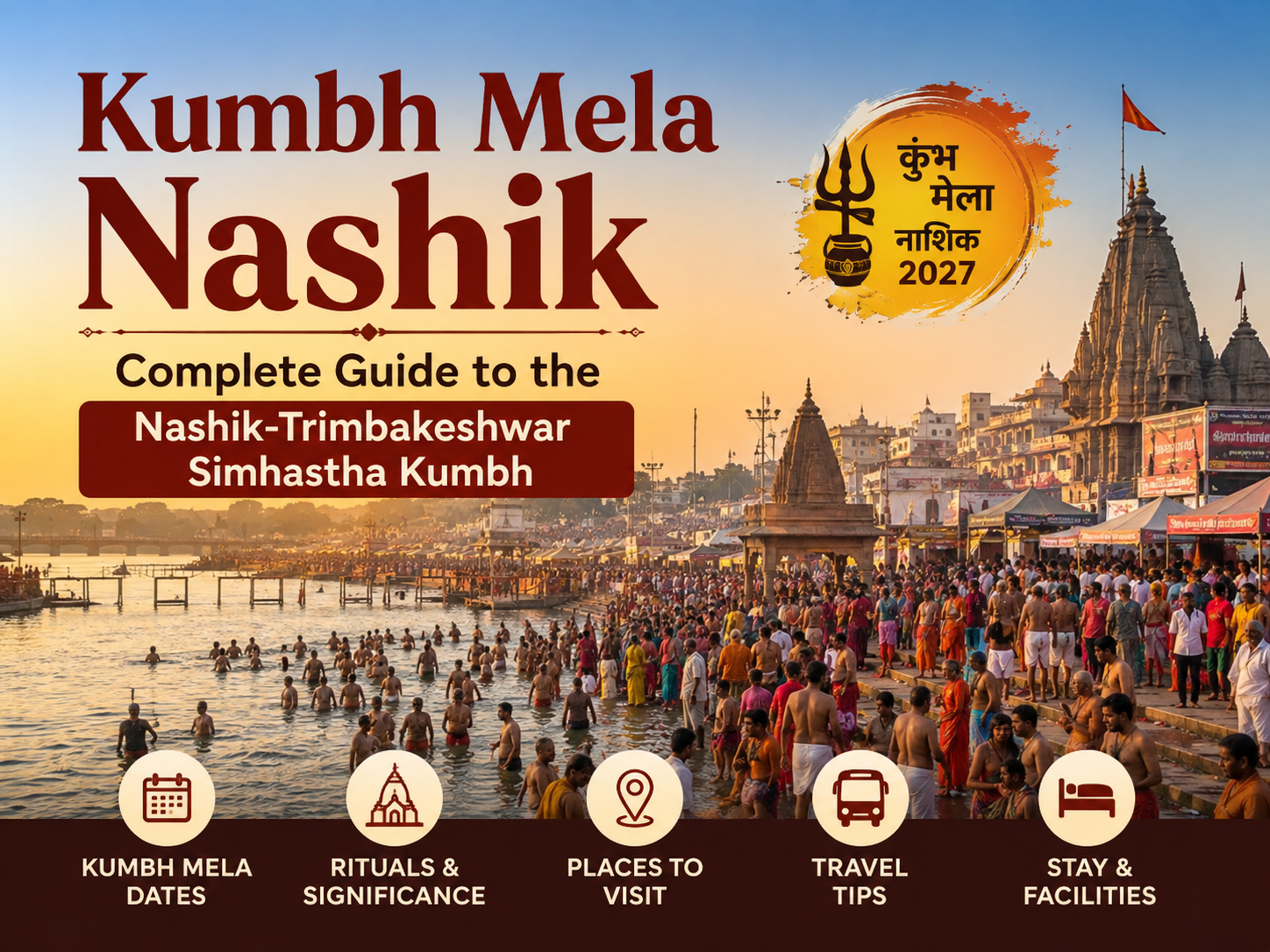
The Nashik Simhastha Kumbh Mela demands early planning due to immense crowds and logistical hurdles. Spanning 21 months from October 2026 to July 2028, the crucial royal bathing days (Amrit Snans) occur in August and September 2027 across Ramkund and Kushavarta Kund. Visitors must book a Kumbh Mela tour package months ahead, prepare for extensive walking, and consider attending on quieter secondary bathing dates or using experienced tour operators to navigate the city.
Most people work out so late that the Nashik Kumbh Mela does not behave like a normal trip. You cannot drive to the river. Book a hotel three weeks out and there will be nothing left. And the bathing dates were locked in long before anyone started looking at flights.
So here is the practical version. Confirmed dates, the Nashik and Trimbakeshwar split, how you actually get into the city, and the handful of decisions that need making before you pay for anything.
What Is the Simhastha Kumbh Mela?
The Simhastha Kumbh Mela is the Nashik and Trimbakeshwar edition of the Kumbh, built around ritual bathing in the Godavari. This one runs long. The 2027-2028 Simhastha Festival spans over 21 months, opening with the flag hoisting (Dhwajarohan) on 31 October 2026 and closing with the flag lowering on 24 July 2028.
Almost everything worth traveling for happens inside 2027, though.
Two places carry the weight: Ramkund in Nashik city and Kushavarta Kund up in Trimbakeshwar.
Nashik Kumbh Mela Dates and Every Confirmed Shahi Snan
There are three Amrit Snans. That is the whole list. These are the royal bathing days when the Akharas process down to the river and take the first dip, with everyone else following behind. The third one is odd, because it splits across two days, one for each town.
| Date | Occasion | Where |
|---|---|---|
| 31 October 2026 | Flag hoisting, official start | Nashik and Trimbakeshwar |
| 29 July 2027 | Nagar Pradakshina, a 14 km circuit of the old city | Nashik |
| 2 August 2027 | First Amrit Snan | Nashik and Trimbakeshwar |
| 31 August 2027 | Second Amrit Snan | Nashik and Trimbakeshwar |
| 11 September 2027 | Third and final Amrit Snan | Nashik |
| 12 September 2027 | Third and final Amrit Snan | Trimbakeshwar |
| 24 July 2028 | Flag lowering, Mela concludes | Nashik and Trimbakeshwar |
Quieter Parvasnan Dates Worth a Look
The secondary bathing days carry real ritual weight and nowhere near the same footfall. Useful if the crowd size is what is putting you off:
- 17 July 2027, Karka Sankranti. The first ritual prayers of the Mela.
- 18 July 2027, Guru Purnima, when attention shifts to the Akhada camps rather than the ghats
- 17 August 2027, Shravan Purnima. Local families turn out in numbers at Ramkund.
- 5 September 2027, Rishi Panchami, favoured for ancestral rites
- 14 November 2027, Kartik Purnima, and thousands of lamps along the Godavari banks
- 26 January 2028, Mauni Amavasya. It falls on Republic Day, so expect heavy security and diversions.
- 23 February 2028, Maha Shivratri, the big one at Trimbakeshwar
- 25 May to 2 June 2028, Ganga Dussehra, with 2 June as the main day
Trimbakeshwar Kumbh Mela and the Akharas
The Akharas in Kumbh Mela are monastic orders of Hindu ascetics, each under a spiritual guru, each running to thousands of sadhus. When they move to the river, it is a full procession. Elephants, horses, chariots, sacred banners.
They do not all camp in one place. The Trimbakeshwar Kumbh Mela belongs to the Shaivite Akharas, the Naga Sadhus covered in ash and carrying trishuls, who bathe at midnight. Nashik city, around Tapovan and Ramkund, is Vaishnavite ground: tilaks, tulsi beads, Hanuman banners, and a grand procession that finishes at Ramkund.
“Naga” comes from the Sanskrit “Nagna,” meaning “naked.” Historically, these were the men who defended temples and the pilgrims walking towards them.
The Shahi Snan days get all the photographs, but they are the hardest days to move around in. Go to the Akhada camps two or three days before a main bathing date instead. You will see the daily rituals and the Havans without fighting anyone for space, and that is usually where the Kumbh actually lands for people.
How to Reach Nashik During the Simhastha
How to reach Nashik is the straightforward bit. It is the last few kilometers that catch people out, because private cars and taxis get stopped well short of the ghats, and you finish on a government shuttle from an outer parking zone.
- Air: Ozar Airport (ISK) sits about 20 km from the city center, with domestic flights from cities including Mumbai and Delhi. Coming from abroad, route through Mumbai (BOM) and allow three to four hours on the road.
- Rail: Nashik Road Railway Station (NK) is a junction on the Mumbai-Bhusaval section, linked to Delhi, Mumbai, Kolkata, and Chennai. Extra trains usually get added for the Mela.
- Road: Buses run constantly from Mumbai, Pune, and Shirdi. The Mumbai-Agra Highway (NH3) is the main artery.
You can try booking a comprehensive pilgrimage tour package from reputed tour operators in India
Kumbh Mela Travel Tips
Useful Kumbh Mela travel tips are mostly logistical rather than spiritual:
- Book accommodation months out. Anything near Ramkund or Trimbakeshwar goes first.
- Bring footwear you can survive 14 km in, especially for the Nagar Pradakshina on 29 July 2027.
- Save your itinerary offline. Networks buckle on peak bathing days.
- Leave a rest day between SNAN dates. Two in a row is heavier than it sounds.
- Save things to do in Nashik and places to visit near Nashik for the gaps between bathing dates, when moving around the city is far easier. Tapovan and Trimbakeshwar are the obvious starting points.
Planning It With Swan Tours
The Nashik Simhastha comes round once in twelve years, and the trips that work are the ones booked early by people who know how the city behaves under that kind of load. Swan Tours has spent years handling exactly this sort of high-density pilgrimage travel, which is a large part of why it is rated the best travel agency in India for festival itineraries.
Talk to our team about a Kumbh Mela tour package built around the Snan dates you want, or a wider Nashik tour package that adds the temples, vineyards, and hill routes nearby.